
Love in Resistance
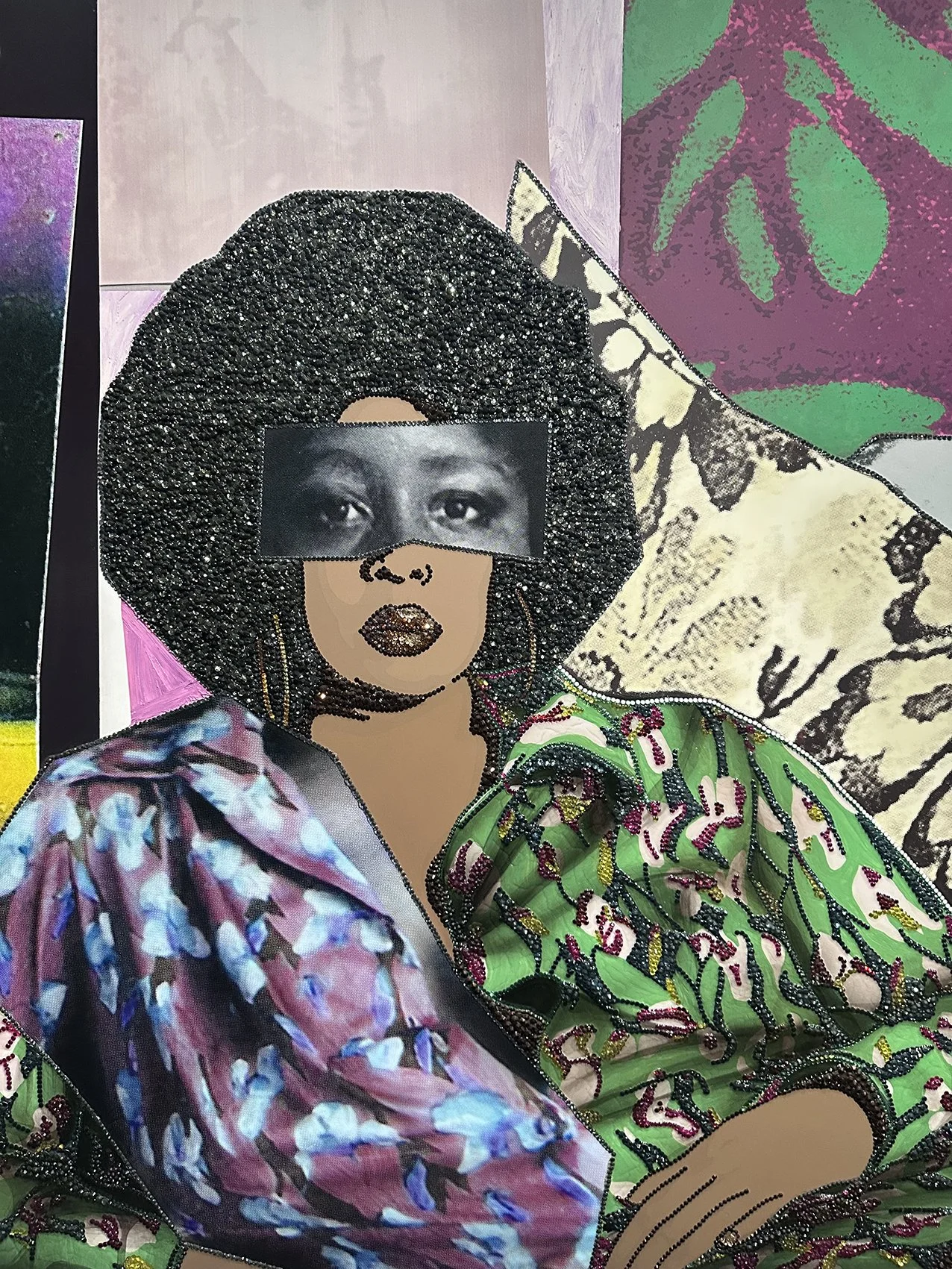
At the Grand Palais, there is a very particular way of entering All About Love: not as one enters an exhibition, but as one crosses the threshold of an apartment—a door left ajar onto an interior laden with memory, music, fabrics, skins, and gazes. Under the Nave, Dazzle as Manifesto: Mickalene Thomas, or Love in Resistance does not merely present a sequence of works; it composes an atmosphere, an affective economy, a magnetic field in which the eye is first seized by splendor—rhinestones, enamels, patterns, visual velvets—before understanding that this splendor is a language, a politics, a strategy. Here, shimmer is not the ornament of a world; it is the grammar of a reclamation. And love, far from being a word laid like a flower over the dramas of History, becomes a force of displacement: a way of overturning frames, undoing the hierarchy of images, relearning how to see.
The title, borrowed from bell hooks, functions more as a key than as a slogan. It is not a matter of illustrating a theory, still less of turning it into décor. For hooks, love is an active ethic, a learning process and a discipline; for Thomas, it becomes a plastic device: love as a technique of montage, as a method of portraiture, as a gentle insurrection. One understands then that the project is not to produce “beautiful images” in a decorative sense, but to fabricate images that would repair—not by erasing violence, but by skirting it, by refusing to let it dictate the horizon. It is all the more radical a gesture because it is deliberately joyful. Joy here is not naïveté; it is an assertion, almost a provocation, in a world that so often demands that Black bodies justify themselves through pain. Thomas chooses pleasure, rest, sensuality, the sovereignty of the gaze. She installs her models not as objects of study, but as subjects who inhabit the image and govern it.
That governance first passes through portraiture, that historical genre in which the distribution of power has been legible for centuries: who has the right to be represented, how, by whom, and for whose gaze. Mickalene Thomas works this tradition the way one turns a garment long worn inside out. Her women—friends, lovers, intimates, muses in the literal sense, that is, forces of inspiration rather than passive figures—do not “pose”: they stand. They hold space. They impose a presence that is neither submissive nor plaintive. The gaze is frontal, steady, sometimes amused, sometimes melancholic, always aware. One senses an intelligence of the body, an acute consciousness of how the body has been seen, framed, desired, fetishized. And this consciousness does not lead to asceticism; it engenders luxuriance. As if the artist were saying: you took our image; we are taking back the stage—but we want it broader, brighter, denser.
This density is deployed at the Grand Palais through a multiplication of media: painting, collage, photography, video, installation. The exhibition route, like a vast mental collage, embraces discontinuities, shifts in rhythm, variations of scale. Thomas is not afraid of excess: she organizes it, makes it breathable, turns it into a principle. In this orchestrated abundance there is something of the baroque and something of pop culture, something of domestic living rooms and something of European museums. The artist knows that visual modernity is made as much from learned icons as from album covers, magazines, fabrics, memories. Nothing is “inferior” in the making of an image: everything can become material, everything can become evidence.
It is here that the dialogue with European art history takes on its most electric charge. When Thomas revisits Manet, Ingres, Matisse—when she reenacts canonized compositions—she does not simply replace one body with another. The gesture is not merely corrective, as if pasting an “inclusive” image over an old one. She shifts the very axis of the painting: energy circulates differently, the posture ceases to be offered, the décor ceases to be a colonial theater in which the female body is exposed to consumption by the gaze. Her odalisques are no longer captives. Her luncheons on the grass are no longer pretexts for nudity. Everything is rewritten from the sovereignty of the Black, queer, female subject. And the rhinestone—this detail some would like to reduce to coquetry—becomes a paradoxical weapon: it attracts the eye like a trap of light, only to force it to linger, to recognize, to confront its own desire for surface. Shine here is not a screen; it is an intensification.
One could nonetheless hear the objection: in its celebration, does the work risk becoming too agreeable? Some critical voices speak of a frustrating seduction, of an overly positive beauty, of a subversion that would remain at the level of décor. Others go further: by replaying the icons of Western art, do these images not remain caught within the very frame they claim to contest, within a scene regulated by a white, male gaze? The question deserves to be asked, because it touches on a deep dilemma of political art: must one break the image or turn it around? Must one refuse the canon or contaminate it? Thomas chooses contamination. She chooses infiltration. She accepts ambivalence, and even stages it: the pleasure of being in the image, and the lucidity about the history that made the image an instrument. This is not an art of purity; it is an art of reprise.
Photography plays a decisive role in this reprise. One senses that everything begins there: in the construction of a set, in the invention of a space the model can truly inhabit. The studio becomes an intimate theater, not to fabricate falseness, but to produce a relational truth: we see bodies at ease, postures that do not betray the fear of being judged. Clothing, patterns, fashion—maternal inheritance, gesture of affirmation—do not serve to “dress” the subject but to declare it. And when Thomas takes up archives, as in Exotic Nudes, the question reverses itself: how does one reclaim an image constructed “by and for” a dominating gaze without reproducing its violence? The artist’s answer is a surgery of the visible: she enlarges, repaints, covers with tinted glass, inlays, recomposes. She alters the photograph until it becomes unstable, as if the archive ceased to be a document and became a battlefield. Fetishization is named, but above all undone through transformation: the image can no longer be consumed as before; it resists because it has metamorphosed.
This metamorphosis finds a darker counterpoint in Resist. Here, collage becomes memory, and memory, accusation. We are no longer in the living room, but in the political fabric of the real: struggles for civil rights, police and carceral violence, slogans, protest archives, strata of time superimposed. Beauty changes register: it is no longer the dazzle that attracts, but the composition that connects, the montage that refuses forgetting. Even when the work borrows a title or a format evoking great modern painting, it is not to grow in its shadow, but to force into the halls of monuments the names and lives that official history relegates to the margins. Here, politics is not a theme; it is the very structure of the image.
And yet, what makes All About Love singular is its ability to hold together these two poles—the domestic and the historical, the velvet of interiors and the harshness of collective narratives—without hierarchizing them. The reconstructed living rooms (those of the mother, the grandmother) are not simple immersive décors meant to “look pretty” under the nave: they are faceless portraits, portraits of spaces, where intimacy becomes archive. The home as a place where the gaze is formed, as a place of survival, as a place where one learns to stand upright. In these rooms, one understands that love is not only romantic love: it is community, lineage, friendship, lovers, transmission, music on repeat, daily tenacity. Love as that which keeps one alive, and therefore as that which resists.
Ultimately, the question is not whether Mickalene Thomas “subverts enough” the history of art. The question is subtler: what does she do to the gaze, to our way of desiring images? She slows it down. She complicates it. She imposes an encounter. Where so many representations have turned Black women into surfaces—surfaces of fantasy, fear, exoticism—Thomas makes the surface active, almost offensive: rhinestones, patterns, patchworks do not smooth things over; they thicken them. They say: you will not pass so quickly. They say: you will look differently, or you will not look at all.
And this is perhaps the most unsettling success of the exhibition: managing to make splendor a critical method. At the Grand Palais, glamour is not a concession to spectacle; it is a tactic of visibility. There is something profoundly political in refusing gravity as the sole proof of seriousness, in refusing pain as the only passport to legitimacy. Mickalene Thomas chooses beauty not as refuge, but as affirmation: a beauty that knows what it costs, a beauty that remembers, a beauty that defends itself. And in this choice, she proposes a rare—almost scandalous—idea: to love, to represent oneself, to celebrate oneself is not to lose oneself in the decoration of the world; it is, sometimes, the clearest way to contest it.
Text by Pierre Bessard, Éditions Bessard, www.editionsbessard.com
Grand Palais, Paris, www.grandpalais.fr